BSK
Basket strainer
Coarse protection ahead of the self-cleaning unit.

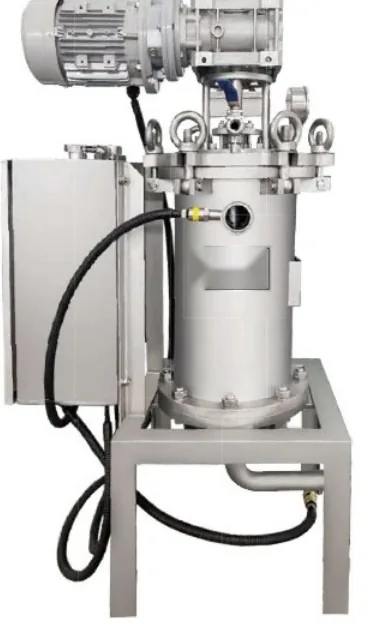
SC · OZZO FilterScraper
Automatic on-line removal for viscous, solids-loaded fluids; the scraper or brush cleans the screen without stopping the duty or changing a consumable element.
Chosen when the fluid carries a high or sticky solids load and shutdown for element changeout is costly. The screen cake is removed mechanically by a scraper or brush driven by electric or pneumatic motor or cylinder; discharge runs on timer or differential-pressure control.
Adhesives, emulsions, polymers, coatings, pigments, inks, coolants, juices and other high-viscosity loaded fluids.
Working principle, advantages, parameters, construction options and application range for this series.
Physical interception plus mechanical scraping removes cake from the screen surface. A PLC-controlled discharge valve (timer or differential pressure) ejects solids automatically. The single unit runs online and continuously, with no filter consumable and no manual cleaning; it has a clear advantage on high-viscosity and hazardous liquids.
| Item | Specification |
|---|---|
| Housing material | CS / 304 / 316L / 2205 / 2507 |
| Screen material | 304 / 316L / 2205 / 2507 / titanium |
| Filtration rating | 30–3000 μm (GLHB 20–2000 μm; internal scraper 20–1000 μm) |
| Screen type | Wedge wire / perforated sheet |
| Viscosity range | 1–1,000,000 cP |
| Design temperature | 0–250 ℃ |
| Design pressure | 0.6–1.6 MPa |
| Discharge mode | Timer / differential pressure |
Coarse protection ahead of the self-cleaning unit.
Fine polishing stage where the duty needs a final element.
Follow a market page for the staged layout and condition basis behind this series.
Parameters below follow the selected construction; final rating, size, temperature, pressure and flow are confirmed against the selected model and process conditions.
Questions buyers most often ask before selecting this series.
Send the medium name and concentration, temperature, working pressure, flow rate, target filtration rating, existing inlet/outlet size and connection, and whether the duty is continuous or batch. If you have a line sketch or pressure-drop record, attach it; we reply with the series, stage arrangement and element direction rather than a generic brochure.
Housing and wetted materials are selected against the actual chemical list, temperature and solids load. The materials listed on this page are the common options; seals and non-metal parts are chosen to match the medium, and the final selection is confirmed in the offer against your process data.
Replacement screens, baskets, bags, cartridges and wear parts are supplied to match the selected model. The change-out interval depends on solids loading and differential pressure; keep the model number and interface on record so the correct spare can be matched.
A scraper suits firm or sticky cake that forms a compact layer on the screen; a brush works better for loose, fibrous or fine solids that a blade may skip. The drive (electric or pneumatic) and discharge control (timer or differential pressure) are chosen against the viscosity and duty cycle.
The self-cleaning unit removes cake mechanically from a reusable screen, so there is no disposable element to change between cycles. The screen and scraper/brush are inspected over time as wear parts; cleaning runs online without stopping the duty.
After cleaning the DP should return near baseline. If it does not, check wear on the scraper/brush, a blocked suction nozzle or drain line, insufficient cleaning pressure, and the inlet solids load; a rating too fine or an undersized area also cycles often. If the gauge reading seems wrong, verify the differential pressure sensor before assuming the screen is clogged.
Share the medium, target rating, temperature and existing interface. We reply with a staged layout and the element direction, not a brochure.